Riverside Roasters · Tuesday · 8:14 a.m.
You're about to
spend $100.
Everyone knows how to make a payment.
Almost no one knows what they just set in motion.
That chirp is all you were ever shown.
Here's everything you weren't.
The part nobody sees
The next 48 hours
of your latte.
A teaching example from the book, simplified but real. Watch the counter above. It's not broken.
-
T+0ms
Your card invents a secret.
The chip generates a code that works exactly once, for this purchase only. Steal it and it's worthless. Your card just protected you, and you never felt it.
-
T+50ms
Seven strangers get involved.
Terminal, payment app, processor, acquirer, network, issuer, fraud model. Your coffee now has more parties than your last contract negotiation.
-
T+250ms
The request crosses the network.
Visa isn't checking your balance. That's your bank's job. The network is a switchboard with rules. The decision belongs to someone else.
-
T+400ms
A model judges your morning.
Your bank's fraud model asks one question: does coffee at 8:14 a.m. near home sound like you? Get judged favorably in under a second, or lose the sale.
-
T+1.9s
The chirp. You walk away.
You experienced a payment. What actually happened was a promise. Verified, reserved, recorded. Look at the counter. No money has moved.
-
9:00pm
You become a line in a batch.
The shop closes out. Your coffee joins 400 other promises in tonight's file. Somewhere, the system is doing the math on who owes whom. Still: zero dollars moved.
-
+2days
The money finally moves.
Bank pays bank. The shop gets its deposit. But look closely. $100 left your hand and $97.50 arrived.
Where's the other $2.50?
The autopsy
$2.50 vanished into a system most people can't name.
Every card payment in America is split the same way. It funds your points, your bank's fraud team, and an industry of middlemen you've never heard of.
The book names every one of them. Who they are, what they risk, and whether they earn their cut.
RIVERSIDE ROASTERS
- YOU PAID
- $100.00
WHERE IT WENT · 2 DAYS LATER
- YOUR BANK "interchange", funds your points
- −$1.75
- THE NETWORK the toll for the switchboard
- −$0.14
- THE MIDDLEMEN the cut most merchants can negotiate
- −$0.61
- THE SHOP KEEPS
- $97.50
CASH USERS: YOU MAY BE HELPING
PAY FOR SOMEONE ELSE'S REWARDS.
EXPLAINED IN FULL · FROM $8.99
USPAYBOOK.COM
Free · one page · PDF
Keep the receipt.
"Where the $2.50 Goes" is the one-page version of everything above: every party named, what each one risks, what each one keeps, and the five rules. Pin it above your desk. Send it to the new hire.
Trade secrets
Five rules insiders know so well they forget to tell you.
They're the hidden operating system of every payment. The book opens with them, because once you have them the jargon sorts itself.
- R1
Payments move data, not money.
The message is instant. The money is on a schedule. Confusing the two is how people get burned.
- R2
Risk dictates the price.
Same card, same amount, yet typed online it costs the merchant more than tapped in person. Follow the risk and you find the fee.
- R3
Four parties run the world.
Customer, merchant, issuer, acquirer. Learn them like a med student learns the chambers of the heart.
- R4
"Approved" is not "paid."
Authorization is a promise. Settlement is money. Days can pass between them, and plenty can go wrong in the gap.
- R5
Interchange is the invisible engine.
A fee you've never seen funds the rewards economy and shapes the price of nearly everything you buy.
Pop quiz
You work near money.
Could you answer these out loud?
Because a pre-authorization is a lingering promise, not a charge, and promises expire on their own schedule. The full mechanics are in Part II.
It depends on a liability game with rules most merchants learn the expensive way. The chargeback playbook is in Part IV.
Because instant also means final. No reverse gear, no nuclear option. Why that changes everything is in Part VII.
That's now a real protocol question, and the newest fight in payments. The agentic era is in Part VIII.
If any of those felt fuzzy: that's the gap this book closes. In about an hour.
What readers say
Reader reviews
0.0 on Amazon · 0 reviews ↗
REPLACE WITH A REAL REVIEW.
REPLACE WITH A REAL REVIEW.
REPLACE WITH A REAL REVIEW.
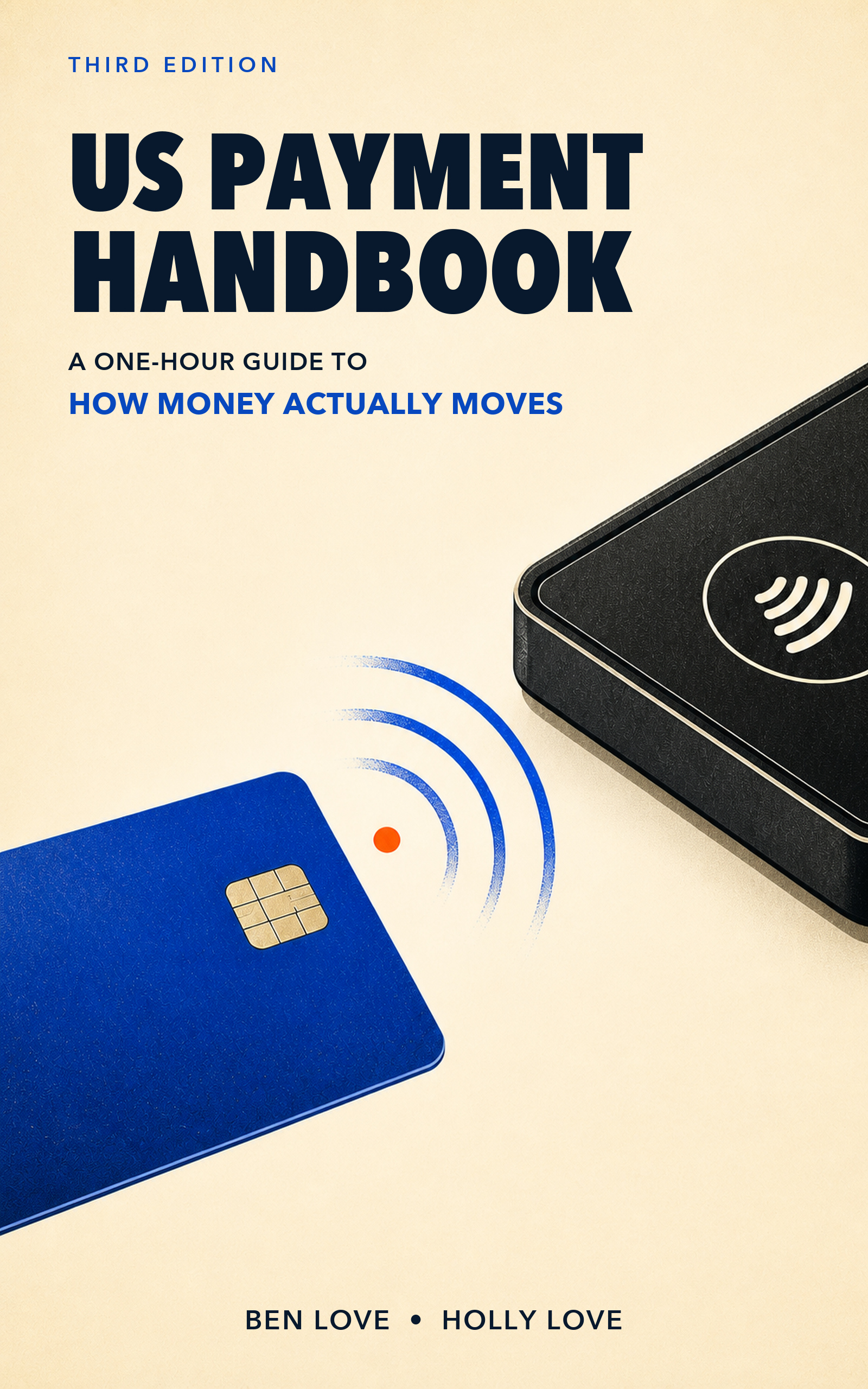
Third edition · Updated through August 2026
One hour from now, you'll see the whole machine.
- The full lifecycle, from tap to settlement, with real timings
- The economics: who takes a cut and what the cut buys
- When it breaks: voids, refunds, and the chargeback weapon
- What's new: wallets, real-time rails, stablecoins, AI agents
- Plain-English glossary + a primary-source research trail
Audiobook $9.99
Paperback $16.99
Hardcover $24.99
Prefer to listen? Get the audiobook on Audible ↗
TXN360 advisory
The book is the hour.
The work is the year after.
Ben has spent 28 years inside payments, in 36 countries, in nearly every seat at the fintech table: product design rooms, ride-alongs with terminal salespeople, and face-to-face research with business owners from coffee roasters to construction contractors. Holly is a product analyst with a new generation's view of how complex systems become useful products.
Together, through TXN360, they advise teams that are entering, building, buying, or leading payment products.
- Years in payments
- 28
- Countries worked in
- 36
- Generations at the table
- 2
Teams · courses · onboarding
The cheapest onboarding program in fintech.
Hand it to every new hire in week one. Pick a pack, or tell us what you're planning and we'll reply with the best next step.
| 10+ copies | Onboarding cohort | |
|---|---|---|
| 50+ copies | Whole department | |
| 100+ copies | Company, course, or conference |
Prefer email? Write to Ben & Holly directly.